What Is a CRM and How Can It Improve Your Business?
Find out what a CRM is, which problems it solves and how it helps organise clients, leads, tasks and business processes. We also explain when it makes sense to develop a customised CRM system.
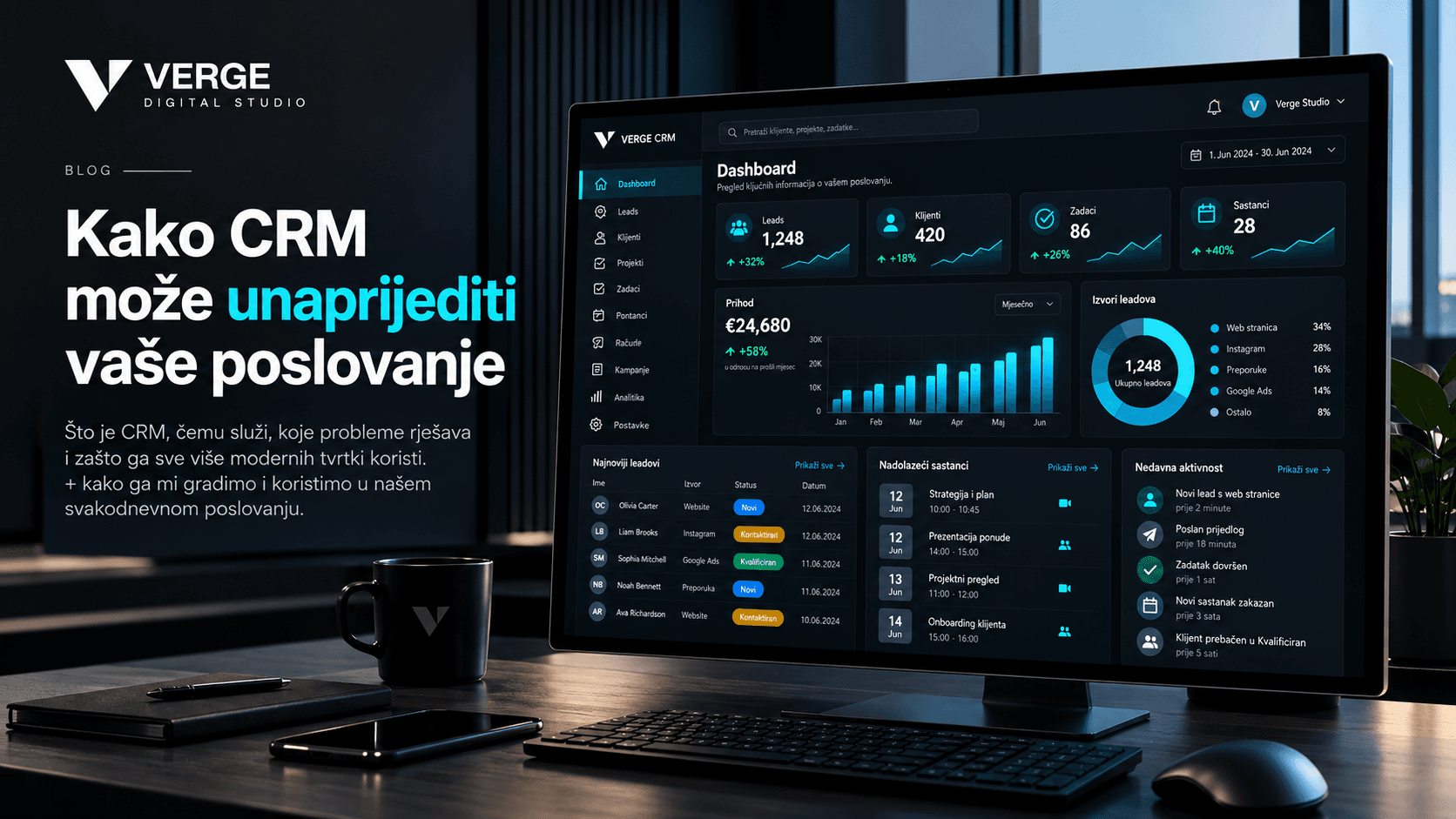
Businesses do not usually become disorganised overnight. The problem develops gradually — a few new clients, more enquiries, additional projects, another employee and, suddenly, important information is spread across emails, spreadsheets, messages, notes and the minds of the people expected to remember it.
This is precisely where a CRM system starts to provide real value.
A CRM is not just a digital client directory. A well-designed CRM connects contacts, sales, tasks, communication and business processes in one place, allowing a business to grow without a proportional increase in administrative chaos.
What is a CRM?
CRM stands for Customer Relationship Management, or a system for managing relationships with clients.
In its simplest form, a CRM stores information about clients and potential clients. However, modern CRM systems can become a central place from which a large part of the business is managed.
A CRM can include:
- Leads and potential clients: who got in touch, where they came from and which stage of the sales process they are in.
- Existing clients: contact details, collaboration history, notes and activities.
- Sales process: quotes, opportunities, deal values and negotiation status.
- Tasks and deadlines: who is responsible for what and what needs to be done next.
- Projects: connecting clients with active projects and internal tasks.
- Communication: records of important conversations, meetings and agreements.
- Analytics: an overview of sales, leads, activities and business results.
The goal is not to have as many features as possible.
The goal is for the information you need to be where you expect to find it.
What problem does a CRM actually solve?
Imagine that a potential client sends an enquiry through your website.
The enquiry ends up in an email. Someone replies. You then speak on the phone and agree that you will send a quote. The quote is sent a few days later, but nobody sets a reminder to follow up.
A week passes.
The client does not get back in touch, and nobody in the company is sure whether the opportunity has been lost, a response is pending or someone has already contacted the client again.
The problem is not necessarily sales.
The problem is a lack of a system.
In a CRM, the same process could look like this:
New enquiry → Contacted → Quote sent → Negotiations → Client
Contacts, activities, tasks and the next action remain recorded at every step.
Which everyday problems does a CRM solve?
1. Enquiries and potential clients are no longer lost
New enquiries can arrive through your website, telephone, email, social media or referrals.
Without a central system, it quickly becomes difficult to track who has received a reply, who needs a quote and who should be contacted again.
A CRM ensures that each lead has its place in the sales process.
At any time, you can see:
- who got in touch
- when they got in touch
- what they are interested in
- who is responsible for them
- what has been done so far
- what the next step is.
2. Information is no longer scattered across ten different places
Some data is in Excel.
Some is in email.
Some is in a WhatsApp conversation.
And a colleague who spoke to the client last week knows the rest.
While the business is small, this kind of system may work. As the number of clients and employees grows, it becomes an increasing problem.
A CRM creates a central client profile containing all relevant data, activities, notes and documentation.
Information no longer belongs to an individual inbox or employee — it belongs to the business.
3. It is clear who needs to do what
One of the simplest questions often causes the most problems:
"Who was supposed to deal with this?"
A CRM allows specific tasks to be connected to clients, projects and responsible people.
Example:
Task: Send a new quote
Client: Primjer d.o.o.
Responsible person: Marko
Deadline: 15 October
Status: In progress
There is no need for additional messages, searching through conversations or relying on memory.
4. Less manual and repetitive work
A large part of administrative work consists of small actions that are repeated constantly.
When a new enquiry arrives, someone has to record the contact, create a task, notify a colleague, set a reminder and later check again what happened.
A good CRM can automate part of this process.
For example, a new enquiry from the website can automatically:
- create a new potential client
- record the source of the enquiry
- assign a responsible person
- create a task
- send an internal notification
- set a reminder for follow-up.
Individually, we are talking about a few minutes.
Across hundreds of clients and thousands of activities each year, we are talking about a substantial amount of time.
5. You gain a true picture of the business
Without organised data, it is difficult to know what is actually working in the business.
A CRM can answer questions such as:
- How many new enquiries do we receive each month?
- Where do they come from?
- How many become clients?
- How many open sales opportunities do we currently have?
- What is their value?
- How long does our sales process take?
- Where do potential clients most often drop out?
- Which tasks are overdue?
- How many active projects do we have?
Instead of making decisions based on instinct, you can make them based on real data.
When does a business need a CRM?
Not every company needs a complex CRM system straight away.
If you have a few clients and a very simple business process, a well-organised spreadsheet may continue to do the job perfectly well for some time.
A CRM starts to make sense when you notice that:
- you have more and more clients and enquiries
- it is difficult to keep track of who you need to contact again
- information is spread across multiple tools
- several people work with the same clients
- tasks or agreements are occasionally forgotten
- you spend too much time entering data manually
- you do not have a clear overview of the sales process
- you want to automate part of the business
- your existing tools no longer suit the way you work.
Put simply — when managing the business starts taking up too much of the time you should be using to run the business itself, it is time for a better system.
Off-the-shelf CRM or a bespoke CRM solution?
There are many high-quality off-the-shelf CRM systems on the market, and for many businesses they are a perfectly good solution.
However, not all companies operate in the same way.
A private clinic does not have the same process as a marketing agency.
A car service centre does not have the same needs as a sales company.
A company working on ten large B2B projects does not have the same needs as a business handling hundreds of smaller enquiries each month.
The problem arises when a company starts changing its own processes simply to fit the limitations of off-the-shelf software.
In such cases, developing a bespoke CRM system may make sense.
What does a bespoke CRM mean?
A bespoke or custom CRM is developed according to the way a particular company actually operates.
Instead of dozens of features you will never use, the system can contain precisely what your team needs.
It could be a simple system for managing clients and sales, or a much broader business platform connecting:
- CRM
- projects
- tasks
- calendars
- documentation
- quotes
- automations
- reports
- internal processes
- AI tools.
Most importantly, technology adapts to the business process — not the other way around.
A CRM does not have to be an isolated system
The greatest value of a CRM often comes when it is connected to the tools the business already uses.
Depending on your needs, a CRM can be connected to:
- website and contact forms
- Google or other calendars
- telephone systems
- accounting
- documents
- newsletter systems
- internal applications
- AI voice agents
- other services through API integrations.
A CRM is then no longer just another application employees have to open.
It becomes a central layer connecting different parts of the business.
How do we approach CRM development at Verge?
At Verge Digital Studio, we do not view a CRM as a list of features that needs to be put into an application.
First, we want to understand the process.
Where does the problem occur?
Which information is currently being lost?
What are employees doing manually and unnecessarily?
Which tasks are repeated?
What can the owner or manager currently not see easily?
Only then does it make sense to discuss technology.
For some, a simple system for clients and sales is enough.
Others need clients, projects, tasks and documentation to be connected.
A third party may need a fully bespoke business system with automations and integrations.
That is why we develop CRM and business solutions tailored to the specific way a company works.
We also use our own Verge CRM in our business
We do not develop CRM systems only for others.
Within Verge Digital Studio, we use our own Verge CRM to manage our day-to-day business.
In one place, we track:
- leads
- clients
- projects
- tasks
- meetings
- activities
- sales opportunities
- key business information.
This allows us to use our own solutions every day in real business situations.
Because there is a significant difference between a feature that looks good in a presentation and one that genuinely saves an employee time every day.
A good CRM should not create additional work
A CRM with more features is not automatically a better CRM.
If an employee has to go through ten screens to complete a simple action, fill in unnecessary fields and manually enter information the system could already know, the problem has not really been solved.
It has only been digitised.
A good CRM should have the opposite effect:
fewer steps, less searching, less repetition and a better overview.
Technology should remove administration wherever possible and give people more time for work that genuinely requires their attention.
A CRM is not the goal — better business is
A CRM is not needed simply because other companies use one.
It is worth introducing when it can solve a real problem.
If information is lost between emails, spreadsheets and messages, potential clients are left without a response, tasks are forgotten or employees repeat administrative work every day that could be automated — the problem is not the lack of another tool.
The problem is the lack of a well-designed system.
At Verge Digital Studio, we develop bespoke CRM and business solutions according to the real needs of companies, from simple client management to more complex systems, integrations and automations.
If you would like to see what a CRM tailored to your business could look like, get in touch.
The goal is not to digitise chaos. The goal is to simplify the process first — and then use technology to make it better.
Got a topic you'd like to talk through?
Let's talk