Bent Bazeni — from a complex offering to a premium digital platform
For Bent Bazeni, we redesigned and developed a new bilingual web platform that brings together pools, the wellness programme, projects, equipment and catalogues in a clear, fast and premium digital experience.
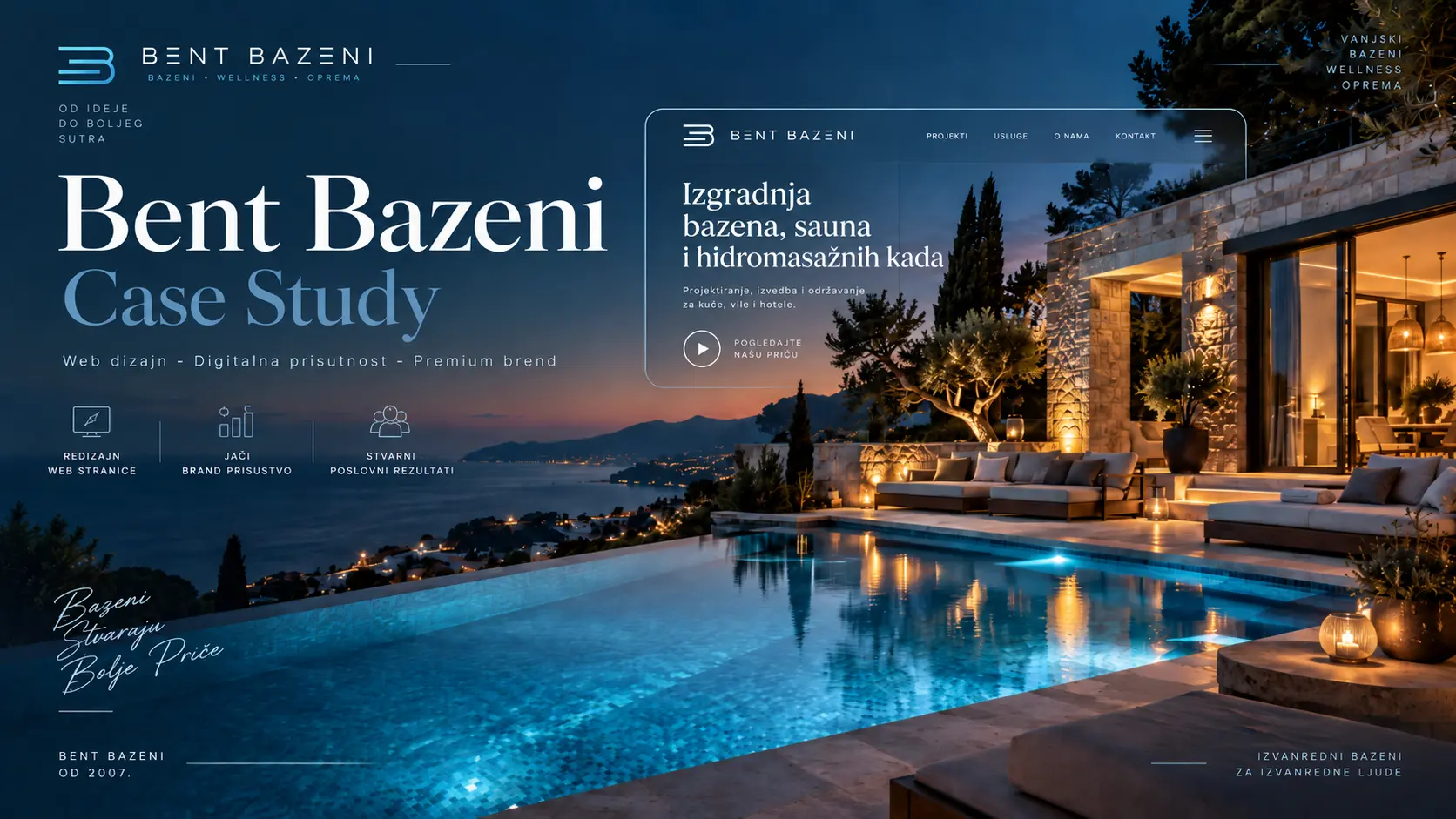
Project
Bent Bazeni have an offering that cannot be presented properly through a few conventional web pages.
Pools with different construction types, pool equipment, the wellness programme, dozens of hot tub models, technical documentation, catalogues and completed projects all needed to function as one whole — without feeling overcrowded.
That is why our task was not simply to redesign the existing website.
The goal was to build a new digital platform capable of organising a complex offering, presenting it in a premium way and naturally guiding users from their first visit to a specific enquiry.
Challenge
With a project like this, the problem is not only the amount of content.
The problem is how to enable users to understand within a few moments:
- what Bent Bazeni offer
- which types of pools they build
- which products and manufacturers they represent
- which projects they have already completed
- where to find technical information and catalogues
- how to send a specific enquiry
At the same time, we needed to preserve the brand’s premium character and build a technical structure that would not become an obstacle as the content and offering grew.
Instead of trying to fit everything into one large presentation page, we divided the project into clearly defined content sections and connected them into a single user experience.
New information architecture
One of the first steps was to organise the offering according to how users actually search for it.
Pools were divided by construction type into separate sections such as concrete, prefabricated, stainless steel, ceramic, polypropylene and polyester pools.
The wellness offering was given its own structure, with separate programmes from the manufacturers Wellis and Treesse.
Pool equipment was further organised into categories such as filtration, pumps, disinfection, heating, lighting, linings, covers, cleaners and water attractions.
This turned a large amount of content into a clear hierarchy in which users do not need to know where something is located — the structure itself guides them towards relevant content.
More than 50 wellness programme models
The wellness segment presented a particular challenge.
The website contains 34 models from the Wellis programme across several collections, as well as 24 Treesse programme models.
Instead of a conventional webshop approach, the products are presented as an informational sales catalogue.
Users can browse the models, their basic features and dimensions, and then continue to a specific enquiry.
This is an important distinction.
For products whose final offering depends on the model, configuration, space and project requirements, a conventional basket is not necessarily the best sales tool.
The digital experience was therefore adapted to the way Bent Bazeni actually operates.
Projects as part of the sales process
Completed projects were not treated merely as a photo gallery.
A structured overview of 19 reference projects was implemented on the website. These can be filtered by project type, property type, location and specific technical characteristics.
This allows visitors to quickly find work similar to the project they are planning themselves.
Selected projects also include a more detailed presentation of the completed work, meaning the portfolio is no longer just a visual addition but becomes an important part of building trust.
Premium visual direction
For pools and wellness products, photography is one of the most important elements of communication.
For that reason, the design was deliberately created so that the content does not compete with the photography.
Large visual areas, controlled typography, sufficient white space and carefully structured sections allow projects and products to remain the focus.
Alongside the basic light interface, a dark theme was implemented. The system remembers the user’s choice and applies it before the page is rendered, avoiding unpleasant flickering during loading.
The entire visual system was built without a ready-made CSS framework.
This gave us complete control over the appearance and behaviour of the website.
Croatian and English as equally important versions of the website
The project was structured as a bilingual platform from the outset.
The Croatian content is located on the primary domain, while the English version uses the /en/ structure and fully translated URLs.
This means, for example, that the Croatian page for concrete pools and its English version differ not only in text, but also have their own semantic URL structures.
The language versions are connected through canonical and hreflang signals so that both users and search engines understand the relationship between the Croatian and English content.
SEO was not added after the design
One of the more important decisions was not to treat SEO as the final step of the project.
SEO was built into the website’s architecture itself.
The following were implemented:
- unique title and meta description data
- canonical URLs
- HR/EN hreflang links
- sitemap infrastructure
- robots rules
- Open Graph and social sharing metadata
- structured Schema.org data
- LocalBusiness data
- breadcrumb structure
- structured data for services
- IndexNow integration
llms.txtfor structured content presentation to AI systems
The structured data was not created to artificially display ratings or reviews that search engines should not treat as independent.
The goal was to build a technically sound foundation for long-term organic visibility, rather than look for short-term SEO shortcuts.
Migration without losing the existing structure
A website redesign does not end with publishing the new design.
Changing the URL structure without a proper migration can leave dozens of old links leading to 404 pages and cause the domain to lose some of the value it has built over the years.
That is why we mapped the old website structure and implemented 79 permanent redirects to the relevant new pages.
Old URLs from the previous WordPress and gallery structures now direct users and search engines to relevant content on the new website.
The primary domain is set to bentbazeni.hr, while the alternative .com and www variants lead to the canonical .hr domain.
Catalogues as part of the web experience
A separate library of technical and product catalogues was integrated into the website.
It currently includes 10 catalogues from the manufacturers Wellis, Treesse and Fluidra.
Each catalogue has its own cover, information about its content, page count and document size, as well as direct access to the PDF document.
This allows users who only want to browse the offering to remain within the simple website experience, while users who need detailed technical information have access to more extensive documentation.
An enquiry instead of a generic contact form
The contact form was developed as part of the sales process, rather than simply as a required contact form at the bottom of the page.
The system records which page the user sends the enquiry from, validates the submitted data and sends the message directly to Bent Bazeni’s email infrastructure.
Server-side validation and several protective mechanisms against automated spam were also implemented.
If JavaScript is unavailable in the browser, the form can still function through a conventional HTML request.
This means that one of the website’s most important conversion functions is not completely dependent on client-side JavaScript.
Performance without unnecessary framework overhead
For the content side of the project, we selected an Astro architecture with static page generation.
Most of the website is delivered to users as pre-generated HTML, while server-side execution is used only where it is genuinely necessary, for example when submitting forms.
React, Vue and other large JavaScript frameworks were not used on the client side.
Interactive elements were written specifically in plain JavaScript.
Most images were prepared in WebP format, content below the initial viewport uses lazy loading, and key hero resources are prioritised during loading.
Even the fonts are downloaded during the build process and served locally, without an additional request to Google’s servers.
Accessibility as part of the implementation
Accessibility was not left until the end of the project.
Navigation includes the option to skip directly to the main content using the keyboard, forms use appropriate ARIA labels, and errors are clearly communicated to users.
The gallery lightbox supports keyboard navigation, Escape to close, focus management and touch gestures on mobile devices.
The website also respects the user’s prefers-reduced-motion setting and stops the automatic hero video in that case.
These are details that many users may never consciously notice.
But it is precisely these details that distinguish a website that merely looks good from a well-made digital product.
Privacy without unnecessary tracking
The current version of the website does not use Google Analytics, Meta Pixel or other visitor-tracking systems.
The website does not set analytical cookies and therefore does not require a conventional cookie banner for such services.
User enquiries are also not stored in a separate database, but are forwarded to the business email address.
This is not an accidental lack of integration, but the current technical and privacy architecture of the project.
Result
Bent Bazeni received much more than a visual redesign.
The new platform brings together:
31 generated pages, a bilingual HR/EN system, more than 50 wellness models, 19 reference projects, 10 product catalogues, a pool equipment catalogue, a contact system and complete technical SEO infrastructure.
Behind the simple user experience is a structure designed so that a large number of different content types function as one coherent whole.
For us, that was the main goal of the project.
Not to create a website that merely looks better than the previous one, but to understand how Bent Bazeni actually operate and turn that complexity into a digital experience that is simple for the user.
Got a topic you'd like to talk through?
Let's talk